Here are some articles that are Still Up on Saubier

Dean2

Member
For those of you interested here is some small calibre info that is still available from the old Saubier site. I plan to copy and paste the cotnent of each article into a separate post in this thread, just in case these links go down to. I would dearly love to be able to get access to the main forum and import all the posts as an archive/library but I don't think that would be all that easy to do.


Old Saubier Articles
 
Last edited:

.17 Jet Project​


Several things got me interested in the .17 Jet but mainly the .17 Caliber load manual from Dick Saunders. Dick developed the .17 Jet or .17-32 Jet as he calls it in his manual. He actually experimented with a couple of versions of this case, but settled on the one that it is currently chambered for by Bullberry (and others) and is referred to as just the .17 Jet. The RCBS die set that I have has the caliber listed as .17 Super Jet.


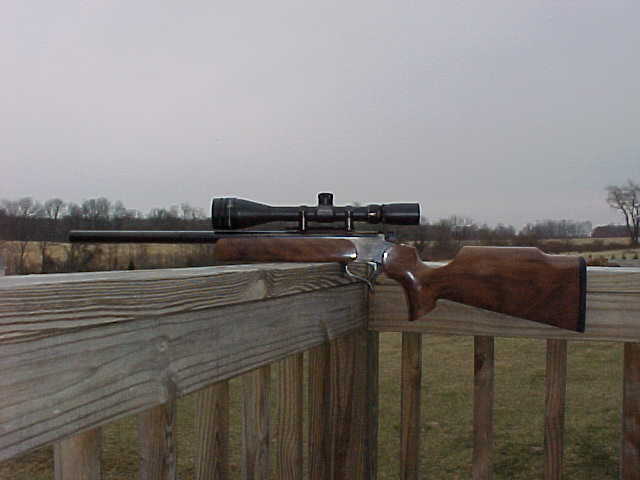
This project is well under way and I hope to have it submitted for print in Small Caliber News by the Fall of this year (2001). I have included a picture of the rifle, which is on a contender frame that has had the trigger pull weight reduced to just over a pound. The barrel was made my Bullberry and is 21" in length, no taper (bull), and gloss blue finish. The stock set was also made by Bullberry actually Woodsmith but I consider them the same. The finish on the stock set is the durable epoxy finish and it is a gloss finish. The wood is a lighter color, lightly figured walnut. The stock has a high comb for use with the scope and a pronounced palm swell. The scope that I chose for this gun is a Sightron 4-16 power scope with target knobs and an adjustable objective.


Image89.jpg


I have formed 250 brass for this gun and am excited about what it has to offer. I have been told that it will safety push 25 grain bullets at 4000+ fps with a very modest amount of powder. I hope to find out soon and I plan on sharing my result with you then. If you want to see what the case looks like, there is a picture of it in my Small Caliber Cases Wanted page. If you would like to read more about this, you will need to wait until it comes out in Small Caliber News. If you have specific questions on this cartridge, feel free to e-mail me. jim@saubier.com
 

.17 Caliber bullet makers​


The following is a list of bullet makers for us small caliber shooters. I have included other pertinent information when available like Ballistic Coefficient. If you have other information to add to this list, please e-mail me.


James Calhoon
Shambo Rt. 304
Havre, MT 59501
(406) 395-4079
www.jamescalhoon.com
Mr. Calhoon provides a wide range of bullet weights available for .17 shooters. He offers 19, 22, 25, and 28 grain bullets. I have tried all but the 25’s.


Genco Bullets
http://www.saubier.com/genco/index.html
(828)684-5797
.17 Caliber offerings.
· *16 grain FB, HP, 6s ogive (drawn from .22/.705" jackets)
· 22.5 grain FB, LT, 7s ogive (J4–.460 jacket)
· 26 grain FB, HP, 7s ogive (J4-.560 jacket)
· 26 grain RBT, HP, 7s ogive (J4-.560 jacket)
· 26.7 grain LT, FB, 7s ogive (J4-.560 jacket)
· 27.5 grain LT, FB, 7s ogive (J4-.560 jacket)
· 29 grain FB, HP, VLD (J4-.635 jacket)
· 32 grain RBT, HP, 7s ogive (J4-635 jacket)
HP = Hollow Point
FB = Flat base
RBT = Rebated Boat Tail
LT = Lead Tip
* These bullets should be able to be pushed at high velocities due to the thicker jacket and light weight.


Budd Tanner’s bullets
22.5 grain flat base bullets, .17 caliber
made on Niemi dies, using J4 ½” jackets.
838 E. Cedar Wapsie Road
Waterloo, Iowa 50703
(319)984-5224


C.E. Nagel bullets
I saw an ad in Small Caliber News for Nagel bullets, and called Mr. Nagel. He bought Clint Starke’s .17 cal equipment and has been making bullets for a year now. He has been shooting .17's for 35 years, has a Mach IV, a Javelina, and a 17-222 with a P.O. ackley barrel. He is currently making 20 and 25 grain bullets. He is using Niemi made carbide dies that were Starke’s, and sounds like he is doing all of the right things. Nice to know that the equipment is going to be put to good use, and that the bullets from them dies are available to the public.
Contact information for anybody who missed the ad in SCN:
C.E. Nagel
(208)267-2860


Berger Bullets
www.bergerbullets.com
There are many different weight bullets offered by Berger for us .17 caliber shooters. Check out the site and give them a try. My experience with them has all been positive. They offer both MEF (Maximum Expansion Factor) and Match.


Kindler Bullets
(330)897-0614.
Todd Kindler makes these bullets by hand and they have been getting good reviews. I have a few boxes on order and hope to test them shortly. Todd can be reached at the Woodchuck Den, which is on my links page. He offers several bullet weights, from light to heavy. All of his bullets are boat tails and boast pretty good BC’s as far as .17 caliber bullets are concerned. I look forward to shooting these soon.


Hammett Bullets
(318)728-2019
I have recently acquired some Hammett bullets to test and will report on them soon as well. I have some loaded up for shooting in my .17 Hebee, but have yet to get a chance to shoot them in less than hurricane force winds. Hammetts are also boat tail bullets. Hammett offers a wide variety of bullet weights and the BC’s are high. I have some 19.8 grain and 22 grain bullets to test. Results will be reported on the site.


Hornady Manufacturing Company
Box 1848
Grand Island, NE 68802
1-800-338-3220


Hornady has two .17 caliber offerings. Their 25 grain hollow point that has to be the most sold .17 caliber bullet in the world. Their newest offering is the 20 grain v-max which is terrific in my opinion. The BC on the V-max is .185. Hard to beat the Hornady bullets, especially if you consider the price.


D.L. Unmussig bullets
(804)320-1165


I have to say that I don’t have much information on his bullets to date and have had little luck getting any. I spoke with Mr. Unmussig on one occasion and have been expecting information on his bullets for 5 weeks now. I have since spoken with Mr. Unmussig and hope to get some information on his bullets soon. He has told me that he makes .14, .17, and .20 bullets – in any weight you could want. I will try to order some in the near future for testing.


Russ Lucas Bullets
(406) 755-8443


Russ makes .14 caliber swaged bullets. He makes these bullets in a variety of weights. I have spoken with Russ and intend to try some of his bullets for a future .14 caliber project. I have seen some mighty impressive stats on the .14’s, including the articles by Blaine Eddy in Small Caliber News.
 

CASE FORMING The Right Way.​


These pictures are all provide by John Delozier(JD) who has begun to do some of my case forming for me. I have formed a number of different .17 cases using the standard Double end forming die from BULLBERRY, and they all have turned out fine. I must say that they dont look as good as the ones that I have received from JD who is using the Redding or RCBS forming dies. I have found enjoyment in learning the process of case forming, but I am not sure that I could convince myself that I like doing it. I may just be bitter, because I formed over 150 .17 Jet cases last night.


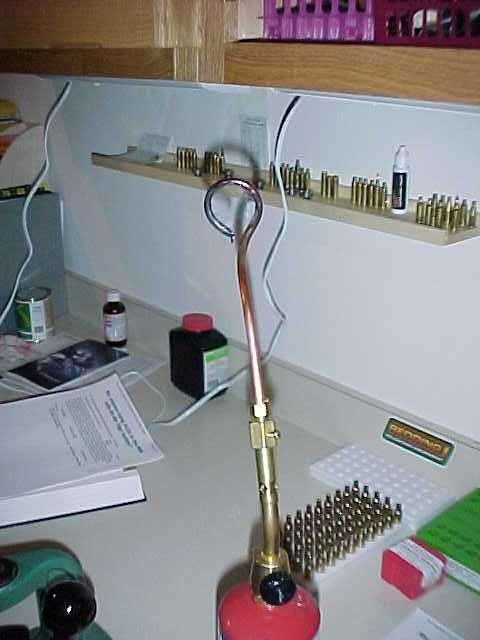
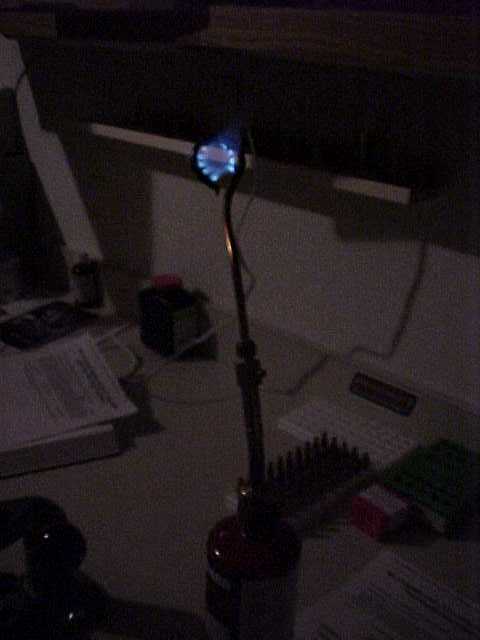
I have found that it is important to anneal these cases to achieve top accuracy and ensure adequate case life. It is less important on some cases like the Mach IV, but I still choose to anneal. I have purchased a Series 2 Annealing tip from the Woodchuck Den that I use to anneal the cases once I have formed them. The phone number for the Woodchuck Den is in my Links section of the page. I have included a picture of this tool below. I place the cases in a baking pan with " of water. I anneal each case individually and nock over with the annealing tip into the water to quench. With the annealing tip came instructions to anneal each case for approximately 15 seconds. I have had a little better luck with close to 20 seconds, but the key is to not over heat the brass. I have found that the annealing tip makes this task rather easy, and now I dont regret annealing like I used to. When annealing the cases, you want to hold the flames at the area that is to be stretched during the fireforming and then upwards to the neck. You do not want to heat the brass until it gets red, you just want to heat until the case begins to discolor to a blue/green color a little. Overheating can ruin the brass.


Image84.jpg
Image85.jpg


Another thing to remember when loading cases for the first time. Load up a few at a conservative to moderate level and shoot. You can then determine if the load will form the cases to your satisfaction before you load them all. If you load them too hot, you may destroy some of the cases by splitting the necks. For the .17s, I like to use a 25 grain bullet for fireforming loads. The heavier weight seems to form the cases a little better. I have had some incredible groups while fireforming, so dont feel like you are just wasting bullets. Load up a bunch of fireforming loads, sight in your gun and go hunting or shooting. My .17 Hebee averaged .5" while fireforming. The velocity was a little lower than standard loads at 3250 fps with the fireforming load (25 grain bullets). There are pictures of my .17 Hebee case forming steps in the Hebee article on my page, so I have not included them here. I will add a photo of the case forming on the .17 Jet when I have a chance.


Check out the pictures below to see what the case forming involves. I have also attached a price list from JD and contact information if you would like for him to form some cases for you.


Image73.jpg


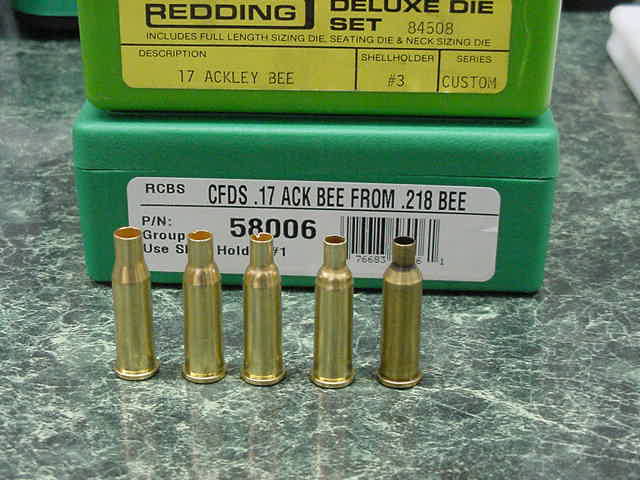
Shown above is a picture of the transformation of .218 Bee case to a formed .17 Ackley Bee case that has been fireformed.


Image74.jpg


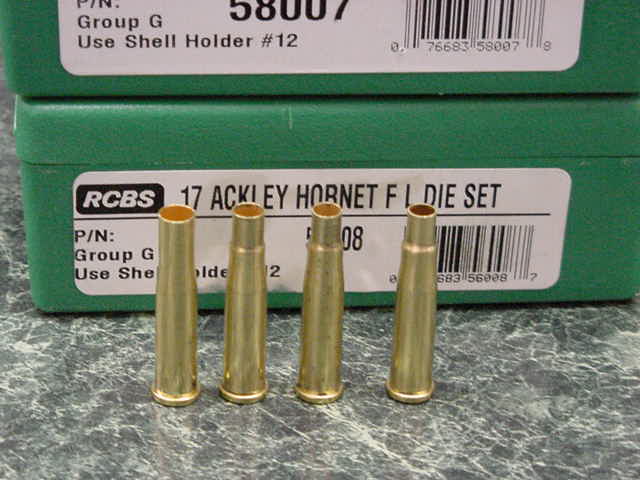
Here are the .17 Ackley hornet case forming steps. Here the transformation is showing the results from each forming step. The fireformed case is not shown, but will be a straight wall case with sharp shoulder angle.


Image75.gif


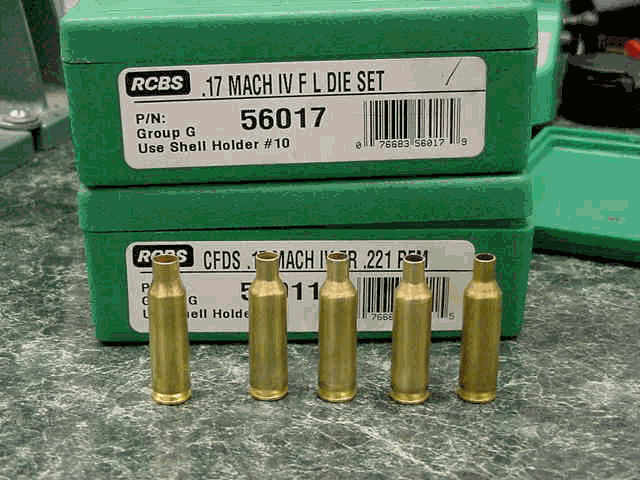
The Mach IV case doesnt have to transform nearly as much as the previous cases mentioned. The forming steps make the case look like the real thing even before fireforming in the chamber. The shoulder angle is not changed and the location of the shoulder is preserved so that the case looks great from the start. The same number of steps are required to form these cases.


Price List (E-mail JD for availability and lead times)


.17 Ackley Hornet (Winchester brass) $30.00/100 pieces


.17 Ackley Bee (Winchester brass) $45.00/100 pieces


.17 Hebee (Winchester brass) $45.00/100 pieces


.17 Mach IV (Remington brass) $45.00/100 pieces


Other small calibers will be added in the future if enough demand is shown. Availability may be limited on some cases based on supply of brass.


All prices include shipping via US Priority Mail and a plastic cartridge box.


E-mail John Delozier at: 59boy@tqci.net
 

Corbin Shell Long Range .17 target​


Letter from Corbin Shell on his LOOOONG range .17. Check out this target.


I am a highpower shooter who mostly shoots longrange (600, 1000 and Palma-8,9,1000yds with iron sights .308 only and 155gr bullets) My thoughts were to build a rifle that would make me pay more attention to the wind which would in theory should make me a better wind reader. While shooting a friends .17, I saw the accuracy potential. All things considered(wind drift, bullet quality, barrels etc) I decided to build a dedicated 600yard rifle to hone my wind reading skills.


To start off credit MUST be given to John Geiges of Geiges Custom Rifles in Youngs Island SC. (843-889-9131 phone). John is one of the finest machinist/engineers I have ever worked with. I explained this novel concept to John and the groundwork was set for him to construct such a laser stick. Actually the rifle is a switch barrel with two bolts. .223 and .308


The target was shot with 30gr bullets in a 9 twist barrel. I also have a 6 twist barrel for shooting the 37gr bullets but have not got the bugs worked out yet. The rundown of components are as follows:

Rifle Builder- John Geiges (843-889-9131)
Stock - McMillan 50/50BR
Barrel- Shilen 9 twist- .875"muzzle, 26" long
Trigger- Jewel set at about 8 oz
Action- Nesika Mod R
Scope rail- Geiges built with 20min of elevation
Scope- Leupold 36BR
Load info:
Rem new cases- group was fired with new brass
Win 760- 25.5gr
30gr Bullets - Berger
Win primers
I am guessing that the velocity is about 3800fps. John built a switch barrel for a friend and this load chronographed 3800 in his rifle.


There are several things that John did which I feel are needed for a switch barrel. Most noted is the removal of the Nesika recoil lug. Slots were machined in the bottom of the receiver to serve as the recoil lug. Keep in mind this is a switch barrel and will be used as a Palma rifle (.308win-155gr bullets).


500pc of brass were ordered. Brass prep included trimming, chamfering, deburring the neck and deburring the flash hole. Thats it. I did NOT cull by weight or neck turn.


After measuring about 50pc of FACTORY loaded ammo and 25pc of the new brass a reamer was ordered. Dave Manson ground two reamers. One for 25 & 30gr bullets and the other for the 37gr bullets. Almost all the brass measured .1935-.194" neck diameter. The reamer was cut with a .197" neck. A little tighter than SAMMI and would still fire ANY factory ammo. Body dimensions were cut to minimum dimensions.


When the rifle was complete I broke in each barrel. Both tubes only took about 10 rounds. Shoot one and clean for a day or so until all the copper was gone.


Now the fun begins!!!!!!!!!!!!!!!!!! Lets go shooting.


I zeroed the 9 twist barrel on some little cups of water at about 60 yards. EXPLOSIVE to say the least. The following week I went to one of our across the course matches at Butner NC. The rifle was zeroed at 200yards on the standard highpower target. Spun on 10min of elevation and went back to 600yards. I got a good elevation zero and that was that.


Two weeks later Oak Ridge was hosting the Tenn State Longrange match. Friday May 4th was a practice day. I brought along the little "toy" as some call the rifle. What better time to try it out. Firing began at the 600yard line. The course of fire is 2 sighters and 20 shots for record. Calm and hazy conditions. The flags were still for the most part. No wind on the scope, elevation on zero. I loaded the first round then bang. PINWHEEL X. DEAD CENTER!!!!!!!!!!!!!!!!!!!!!!!!!!!!!!!!!!!!!!!!!!!!!!


Lindsay and Mark Barnes (highpower shooters) were pulling the target and could not believe what had just happened. Mark "The Mighty Barnes" called up on the radio and commanded I "tighten up". Second sighter was a 10 at 12 o'clock. Just 20 more shots to go. Everything was going pretty good as I was shooting better than 50% X's. Then I saw the mirage pick up from the right to left. Not knowing just how much these little pills were going to blow I decided to hold midring 10 at three o'clock. The bullet went wide to the right but still in the ten ring. This left me scratching my head. Oh well the next shot I held center. X . When it was all said and done the official count was 200-11x. Thank goodness we put up an new target center. Several people signed and dated the target including Pete Laberge-US Palma Team captain.


There were a lot of people on the line just shaking there heads. "No way" was the general consensus. The fun had only just begun. Next stop the 1000 yard line. I spun on 32min of elevation, windage zero. Bang. The target goes down. Good windage, high at 12 o'clock. Clicked down 2 min, bang the target goes down. Mid ring 9 at 6 o'clock. I shot about six or eight more shots. My group was about 12-15". Everyone on the line could not belive what had just taken place. The bullets were subsonic after about 750-770 yards but still cut paper clean. Not a one keyholed.


To date there are right at 60rounds through the barrel. Barrel wear should be about like the the 6.5mm we shoot at longrange. 1100-1400 rounds. Heck barrel makers have to eat to :))))


Sense I started this project one person in particular has stuck in my mind - Todd Kindler. Before starting the project I called Todd and explained what my intentions were and he basically called me a fool. Well the proof is in the pudding and the pudding is on the paper!!!!!!!!!! By the way this was my first attempt shooting the little laser stick at 600yards for a full string of 22 shots.


Image98.jpg


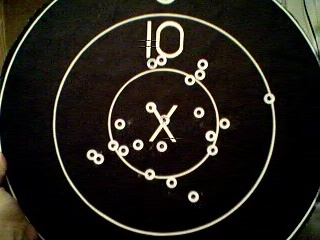
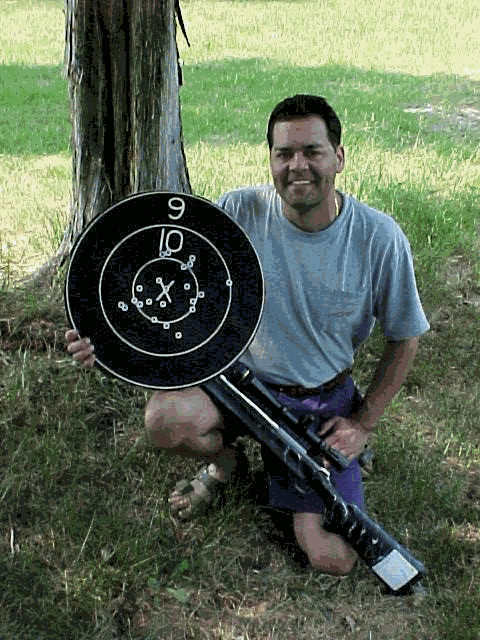
Above is a photo of the 600 yard target. the score was 200-11x. The frist sighter was the pinwheel X and the second sighter was one of the 10's as twelve o'clock. The ten out to the right is INSIDE the line. I saw the wind pick up going from right to left and I held midring 10 at 3 o'clock. Damn if the bullet did not go almost were I was pointing. It rattled me a bit as it did not make sense because I held to the right and the mirage increased from right to left. Oh well it still went into the 10 ring. Look at how close the 10's are around the X ring. Not too bad for a little .172 diameter bullet. Jim you would not belive how many people TOLD me a 17rem would not work at 600yards. Well I guess these people are "Book" shooters. By the way I also shot it at 1000yards. My calculations said the bullet went subsonic at about 750-770yards. It still went thru the target straight and did not keyhole. The come up from 600 to 1000yds was 30.75min. First shot struck paper with 32min of elevation. Everyone on the line was AMAZED!!!!!!!!!


Image99.gif
 
EXTREME Small Calibers​


While at a large outdoors show, I stopped by Tom Thomas booth. For those of you who arent familiar with him, he is the owner of The Outdoorsman and handles a lot of small caliber rifles including Cooper, Cascade, Kimber, and others. Dan Cooper happened to be there that day representing Cooper Arms. I had lengthy conversations with Dan and Tom about the small calibers. Toms wife handed me two small plastic bags with the stuff that I had bought. I didnt look at them very closely until leaving, but they were promotional cartridges from Bill Eichelberger.


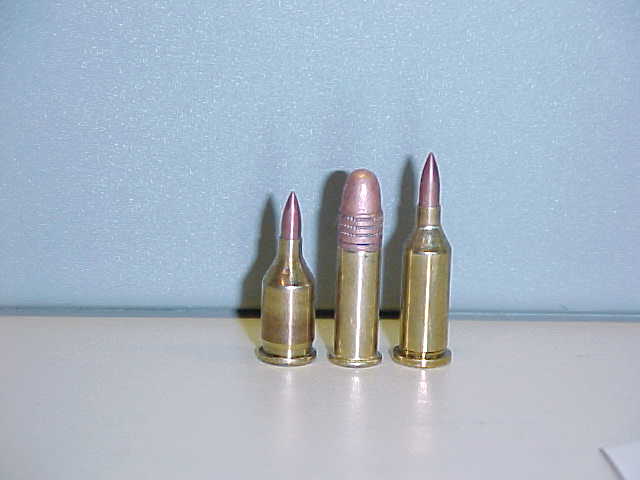
Bill Eichelberger is considered the industry expert for all of the sub .17 calibers. He has manuals for the .14 (I have this one) and for the .12. He has recently done some work with the .10 calibers and the two cartridges that I got were .10 caliber. Yes, thats right, I said .10 caliber. Why you might ask, does anybody need a .10 caliber. Below is a picture of the two cartridges with a .22 long rifle round in the middle for comparison sake. These wildcats are based on the CCM case and the .25ACP case and are called the Dart and the Pup. I dont have any performance information on these, just the cases.


Image95.jpg


I am very glad to have received these cases and look forward to working with a .14 sometime soon. Think small.
 
I posted this as multiple posts due to the length. Unfortunately the pictures no longer show up on Saubier so could not be copied, and the charts are too large. They exceed the post size limit.

Its a Hebee?​


I began my quest as most all of us do, in search of a new gun. I have a passion about the small caliber stuff, .17 in particular. I already had a .17 Remington, and was looking at something a little smaller to push the 20-22-grain bullets efficiently. While the Mach IV is very popular and much easier to get information on I wanted something a little different but close in performance, so I chose the .17 Hebee. Rather than telling some glorious statistics and deductive reasoning about why I chose the Hebee, Ill default to the truth I wanted to be able to say, "Its a .17 Hebee," while at the range.


The .17 Hebee was developed by Dennis Hrusosky a number of years ago as an improved version of the .17 Ackley Bee. The Hebee has a shorter neck and longer body, which gives it more powder capacity. The Hebee is based on the .218 Bee, a rimmed case. The rimmed case lends itself to the single shot Encore action. The rimmed cases are thought to be stronger in the case head area, making loose primer pockets nearly extinct. Shown in Figure 1 are the cases in order from left to right: .17 Ackley Hornet, .17 Ackley Bee, .17 Hebee, .17 Mach IV, and .17 Remington.
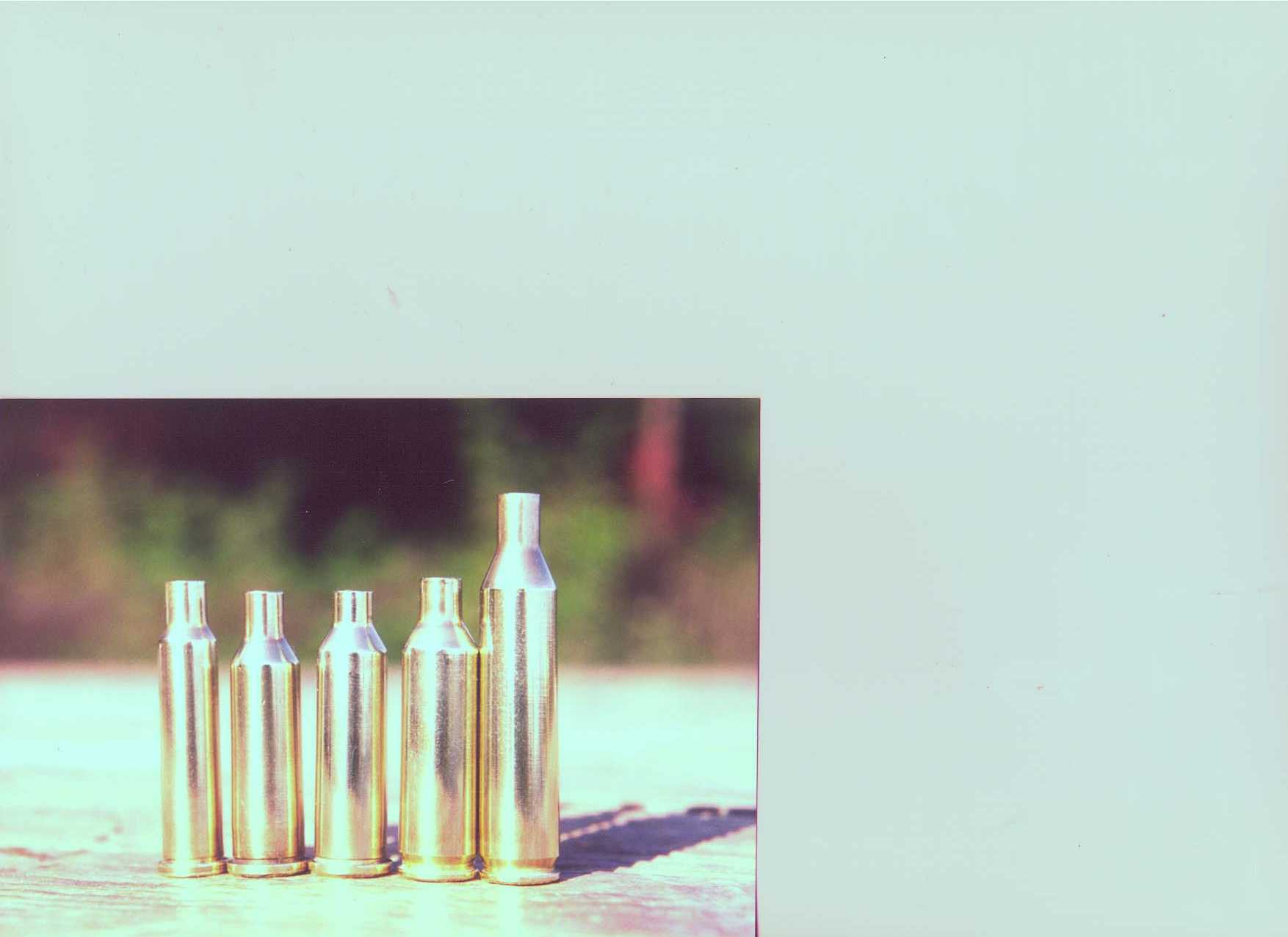

hebee


I commissioned Fred Smith of Bullberry to make the barrel, and Woodsmith Inc. to make the stock set, based primarily on reputation as this was to be my first Bullberry purchase. I also ordered the Bullberry double end forming die and a Redding full length die set. This was to be my first experience with the double end forming die, and I had no idea what it would look like. Redding also makes forming dies for the Hebee, but I chose to use the Bullberry version, as I could use this forming die for other .17 caliber projects in the future.


At this point I had barrel, stock set, and dies all ordered, but I still had to get some brass, bullets, case holder, and other miscellaneous stuff required for a .17. Another call to Todd Kindler at the Woodchuck Den was all that was needed to get the stuff en route. One thing that continues to astonish me is Todds ability to have everything that I need in stock and ready to ship either he carries a large inventory or I am extremely lucky. Todd had the Wilson case holder (.17 Hebee) in stock, the flash hole deburrer, and the bore guide. Todd is also a great source of information and is willing to take the time to talk to you about your project. He has helped me since the beginning when reloading for my .17 Remington.


I already had Todds "Sensational Seventeens" compilation, so I was familiar with the expected ballistics of the Hebee. Based on case capacity and desired velocities, I chose the 19 22-grain bullet weights. I was hoping to push the 19-grain bullets at 3900 fps, and the 22-grain bullets at 3700 fps. I have had great success with the Starke bullets, so after speaking with Clint Starke, a box of 20-grain RPVBs were on the way. I rounded out my bullet selection with James Calhoon 19-grain and 22-grain double hollow points, Hornady 20-grain V-maxes, and Berger 22-grain MEFs. There are many more .17 caliber bullets made, but I chose these based on previous success. I would also like to try some of the Kindler 23-grain boattails in the near future.


When dealing with any wildcat, determining which powder is suitable or even preferred can become a challenge. I chose to work with both Vihtavouri N130 and Reloder 7 powders based on load data in Sensational Seventeen manual and Dick Saunders ".17 Caliber Shooting" manual. These were the sources of information that I had available and felt most comfortable with. I intend to try some Accurate Arms 2200 powder in the future as James Calhoon recommended it as his first choice, but it only comes in 8-lb. kegs and Maryland only allows purchase of 4-lbs per day of powder.


Another great way to get information on a specific caliber is on the Internet especially www.varminthunters.com on the Go Go Varmint Go message board. This is a great place to ask questions regarding the small caliber stuff, as well as reloading questions. I can post a question on the .17 Hebee and get responses from others that either currently load for or have loaded for in the past.


Two packages arrived on the door step brass, bullets, forming die, and Redding full length die set. I now had everything needed to begin the case forming process. I found directions with my Bullberry double end forming die. In something of a new concept for me, I decided to read the directions, since they were on one half sheet of paper, and numbered 1-4.

The forming die (See Figure 2) is threaded to fit in my reloading press and is stamped on each end with 1 or 2. One problem that I found when using the Bullberry double end forming die was that there was no nut on the die and the thread-slop allowed the die to wiggle while in the press I added a nut from one of my other die sets to alleviate this problem. I also felt the need to polish the die, as there were tooling marks from the machining process as evidenced by the scrape marks on my case necks. Im not sure if either of these things would have affected performance, but I felt like doing them. I formed approximately 50 rounds before polishing the forming die, and had no detectable problems, but have gotten in the practice of polishing all of my dies using Flitz Metal Polish.


The case-forming steps are as follows:


  1. Chamfer inside and outside of case mouth.
  2. Lube the case neck and shoulder area.
  3. Run through Side 1 of the forming die.
  4. Run through Side 2 of the forming die.
  5. Use Redding FL die to complete the neck.

Note: Be sure to apply adequate lube between steps, otherwise a stuck case may result. Figure 3 shows the results from each forming step.

As the cases are sized through the 3 dies the brass becomes work hardened, and annealing is necessary to return the neck and shoulder area of the brass to the dead soft condition. The annealing should be done before fireforming to prevent splitting of the case neck and to aid in the expansion of the case during fireforming.


The case head must not be annealed, as it will become too soft and could rupture during firing. To aid in the annealing process, I made a case holder to act as a heat sink while I rotate the brass in the flame. My case holder looks something like the one that came with the Wilson case trimmer that I use. I machined it with same taper as the case so it makes good contact, improving heat transfer. The case holder is placed into a machined aluminum device that is held in a drill. This contraption worked very well, and I can use it for other case sizes in the future, just by machining new case holders. I used three of them for the Hebee, so that I could keep going while they cooled down.


Once the case is brought up to temperature, it is dunked into water for quenching. The cases should not be trimmed until after fireforming, as they will stretch when they are fireformed and resized. The cases are now ready to have the flash hole deburred, using a special tool I obtained from the Woodchuck Den, and the primer pocket squared.
 
Last edited:
Hebee part 2

Figure 4 shows the Encore with Bullberry stock set, and 20" full bull bullberry barrel in .17 Hebee (try saying that 10 times). The fit and finish of the stock set are excellent, and the quality of the wood is breathtaking. A picture just cant do this wood justice. The 2" wide target style forearm matches the stock beautifully. The Swift 6-18X 44 scope is mounted in Burris Zee rings on a Weaver style base.


I need to take a moment to give praise to the Swift scope. A local gun shop (Mallins Guns) that I buy some of my reloading supplies from is a Swift dealer. I never owned a Swift scope before, but I tried a couple and was impressed by the warranty and optical quality. I needed a good scope for my Hebee project, so I decided to try the Swift. I am delighted with its lens quality, light transmission, and tracking. The fine cross hairs are great for shooting at small targets at long distances. The field of view is clear all the way out to the edges throughout the power range of the scope. I have no problem seeing the tiny holes at 100 yards. The target knobs are big and I get distinct clicks when adjusting. I have raised and lowered the elevation with the target knobs and changed the right and left windage a number of times. The point of impact returns to zero on all occasions. The price of these scopes was another pleasant surprise, and overall I consider it a very good deal.

For fireforming, I used a reduced powder charge (13grains) of Reloder 7, and a 25-grain Hornady hollow point. I didnt intend to use 25-grain bullets in this cartridge, but the heavier bullet helps to ensure that the case is formed fully during fireforming. There are other methods of fireforming, but this one was successful for me, and the fireforming loads actually performed very well, and I used them also to break-in the new barrel.


I first loaded one round with the reduced load and fired it to see if it would blow out the shoulder completely. I seated the bullet to just touch the lands. It worked, so I loaded 50 prepped cases. I only had 50 Hornady 25-grain HPs left, so I stopped loading when I ran out.


I used the first 13 rounds to break in the barrel and sight in the scope, cleaning after each shot. Then I began the sequence of 1 fouler out of the clean barrel, then 5 shots for the group, then clean after each group.


I shot 6 groups at 100 yards using the Hornadys with an average group size of .581". The largest group was .687", and the smallest was .436". I loaded the rest of the fireforming loads with 25-grain Bergers, just because those were what I had on hand. I shot some groups using these and had a best of .311" and a worst of .856" at 100 yards. Seen in Figure 5 is a group shot while fireforming. I shot a few over a chronograph to determine the velocity of these loads as well, and got an average of 3,290 fps.
 
Hebee Part 3

I was very pleased with these groups and had high hopes for the load development. I did lose one case in the fireforming process due to a split shoulder. The barrel cleaned up with a few wet patches of Shooters Choice after each group. I used Sweets to remove any copper after my shooting session and was pleased at the very small amount of copper that was present. It was nothing like cleaning my factory barrel .17 Remington.

One problem that I ran into was cleaning a 20" barrel with a 38" cleaning rod. It was very awkward using such a long rod for such a short barrel. I had some difficulty finding a short enough rod, but I found that Pro-Shot makes a 22.5" rod in .17 caliber. This is just what the doctor ordered for us .17 caliber shooters with 19 20 inch TC barrels. Including the supplied brass spear point jag, the cleaning rod cost $19.99.

After fireforming, prior to load development, some additional case preparation is necessary. I started by trimming the cases to length using my Wilson case trimmer which holds the case perfectly perpendicular to the cutter head. I read in my "Sensational Seventeen Manual" that the trim to length was supposed to be 1.355 but I am pretty sure it was a misprint. I consulted my Lymans 47th loading manual for the .218 Bee and the trim to length was 1.335". I also measured all of my cases and had none even close to the 1.355. With the already short neck of the Hebee, I trimmed as little as possible to get all of the cases the same, which ended up being very close to 1.335".

Once all of the cases were trimmed to length, I used my brand new Forster outside neck turning tool. This is a compact hand tool, which is exactly what I want for case preparation. I enjoy taking my case preparation tools away from the bench, so I appreciate the portability. The other impressive feature of this tool is the micrometer adjustment knob with .001 index marks that allow it to be set to within half-a-thousandth of an inch. The Forster uses a carbide cutter to do the work. Carbide isnt affected as much by temperature as high-speed steel, and remains sharp longer. I am not going to detail the importance of neck turning, but I will just state that I feel it is worth my time investment.

I have included tables showing loading parameters, group diameters, and some analyses of the distribution of impacts. In addition to the familiar group diameter, I like to measure the horizontal and vertical coordinates of each impact. Then I can enter them in a spreadsheet that computes the center of impact and the horizontal and vertical standard deviation (SD) of each group. This way each hit can be analyzed separately for horizontal and vertical spread. Fliers can be defined quantitatively, and usually a flier is only out in one direction or the other. The criteria I used for a flier was that it must be more than three times as far from the center of impact as the SD of the other 4 hits. In a normal distribution, 99.96% would be found within 3 SD of the center. Another benefit of the spreadsheet is that I can print out "virtual" targets for each group or put several groups on one target.

Load development started with Vihtavouri n130 powder and Starke 20-grain bullets. I adjusted the seating depth so that the bullets were just short of the lands. I loaded up starting at 13.5-grains and increasing in 0.3-grain increments up to 15.8 grains of n130 without any significant pressure signs. This combination proved to be very accurate with some very good groups. See Table 1.


Hebee Part 3

I was very pleased with these groups and had high hopes for the load development. I did lose one case in the fireforming process due to a split shoulder. The barrel cleaned up with a few wet patches of Shooters Choice after each group. I used Sweets to remove any copper after my shooting session and was pleased at the very small amount of copper that was present. It was nothing like cleaning my factory barrel .17 Remington.

One problem that I ran into was cleaning a 20" barrel with a 38" cleaning rod. It was very awkward using such a long rod for such a short barrel. I had some difficulty finding a short enough rod, but I found that Pro-Shot makes a 22.5" rod in .17 caliber. This is just what the doctor ordered for us .17 caliber shooters with 19 20 inch TC barrels. Including the supplied brass spear point jag, the cleaning rod cost $19.99.

After fireforming, prior to load development, some additional case preparation is necessary. I started by trimming the cases to length using my Wilson case trimmer which holds the case perfectly perpendicular to the cutter head. I read in my "Sensational Seventeen Manual" that the trim to length was supposed to be 1.355 but I am pretty sure it was a misprint. I consulted my Lymans 47th loading manual for the .218 Bee and the trim to length was 1.335". I also measured all of my cases and had none even close to the 1.355. With the already short neck of the Hebee, I trimmed as little as possible to get all of the cases the same, which ended up being very close to 1.335".

Once all of the cases were trimmed to length, I used my brand new Forster outside neck turning tool. This is a compact hand tool, which is exactly what I want for case preparation. I enjoy taking my case preparation tools away from the bench, so I appreciate the portability. The other impressive feature of this tool is the micrometer adjustment knob with .001 index marks that allow it to be set to within half-a-thousandth of an inch. The Forster uses a carbide cutter to do the work. Carbide isnt affected as much by temperature as high-speed steel, and remains sharp longer. I am not going to detail the importance of neck turning, but I will just state that I feel it is worth my time investment.

I have included tables showing loading parameters, group diameters, and some analyses of the distribution of impacts. In addition to the familiar group diameter, I like to measure the horizontal and vertical coordinates of each impact. Then I can enter them in a spreadsheet that computes the center of impact and the horizontal and vertical standard deviation (SD) of each group. This way each hit can be analyzed separately for horizontal and vertical spread. Fliers can be defined quantitatively, and usually a flier is only out in one direction or the other. The criteria I used for a flier was that it must be more than three times as far from the center of impact as the SD of the other 4 hits. In a normal distribution, 99.96% would be found within 3 SD of the center. Another benefit of the spreadsheet is that I can print out "virtual" targets for each group or put several groups on one target.

Load development started with Vihtavouri n130 powder and Starke 20-grain bullets. I adjusted the seating depth so that the bullets were just short of the lands. I loaded up starting at 13.5-grains and increasing in 0.3-grain increments up to 15.8 grains of n130 without any significant pressure signs. This combination proved to be very accurate with some very good groups. See Table 1.

I then switched to Reloder 7 and loaded up to a maximum of 15.4 with the 20-grain Starkes. I had some primer cratering with the Starkes at this level but no ruptured primers or sticky extraction. The Starke 20-grain bullets proved to be great with either of the two powders, with some of the groups being in the .3 - .4 inch range. I was unable to get a chrono reading on the Starkes with the n130, but got a velocity of 3884 fps with 15.4 grains of the Reloder 7. See Table 2.

I then loaded some 19grain Calhoons using the n130 in the same manner. The groups with this powder/bullet combination were not as promising as I had hoped, so I discontinued further development. One thing that I noticed was that the suggested maximum velocity for these is 3800 fps, and I am sure that I exceeded this velocity. I loaded some of the 22-grain Calhoons with the n130 also. Although better than the 19-grain Calhoons, this combination didnt suit my Hebee either. I would still like to try some heavier Calhoons at a velocity around 3700 fps to see if I can find a combination that extracts their potential. See Table 3.

Still using the n130, I loaded up some of the Hornady 20-grain V-maxes. I got up to a maximum of 15.5 grains before I started to see some primer cratering. At this charge, I recorded an average velocity of 3844fps, a little lower than I got with Reloder 7. I probably could have loaded these a little hotter, and I intend to try some at 15.8 grains.


With 15.4 grains of Reloder 7, the V-maxes achieved an average velocity of 3915 fps out of the 20" barrel. With the Encore, I could feel some sticky extraction when opening the breech with these loads. The primers looked cratered and flat, but didnt leak or rupture. I reduced to 15.2 grains and didnt experience any additional problems. I will have to keep an eye on this load and possibly reduce further for warm weather shooting as it was 40° F when I shot the load at 15.2 grains, compared to 70° F when I experienced the pressure signs with 15.4 grains.


Accuracy with this load was good, and I plan on doing some follow-up work to evaluate further. I did have some impressive groups with the v-maxes and Reloder 7. See Table 4. All measurements are in inches; range was 100 yards.

 
Shortly before press time, I received some of the 22-grain Bergers that I had ordered some time ago. As most of you probably know, the Bergers have been difficult to get recently. I will need to spend some additional time with these, as the gusty wind would not cooperate on the day that I was testing. In spite of the wind, I did have some pretty decent groups with the Bergers with both powders. The velocity of the 22-grain Berger with 15.8 grains of n130 was 3868 fps, but showing some difficult extraction and primer cratering. With 15.4 grains of Reloder 7, the velocity was 3848 fps. Even with a wind of 15 25 mph, I had a couple of groups measuring less than .75". See Table 5. Studying the targets several days after firing these loads, I noticed two or three oblong bullet holes, suggesting that some bullet yaw was induced, possibly due to too hot a load.


While there is always additional load development that can be done, I feel that I have some very good loads. The gun looks terrific and performs well, but a lighter trigger pull would be welcome.

The accuracy of the fireform loads was so good I may try some of the 25-grain bullets for further development. Case forming was rather time consuming, but not particularly difficult. I only lost 3 cases during the entire project due to split shoulders. The Starke 20-grain bullets seemed to give the most consistent small groups, with the Hornady V-maxes in a close second. I have high hopes for the 22-grain Bergers and have loaded up some additional rounds to shoot when the wind will cooperate. I hope to evaluate some 23-grain Kindler boattails in the future as well.


The carbine stock and forend set from Bullberry/Woodsmith Inc. is the nicest wood that I have personally seen. I am always getting compliments on the appearance of this gun, but not one person has ever heard of a Hebee.
 
Shortly before press time, I received some of the 22-grain Bergers that I had ordered some time ago. As most of you probably know, the Bergers have been difficult to get recently. I will need to spend some additional time with these, as the gusty wind would not cooperate on the day that I was testing. In spite of the wind, I did have some pretty decent groups with the Bergers with both powders. The velocity of the 22-grain Berger with 15.8 grains of n130 was 3868 fps, but showing some difficult extraction and primer cratering. With 15.4 grains of Reloder 7, the velocity was 3848 fps. Even with a wind of 15 25 mph, I had a couple of groups measuring less than .75". See Table 5. Studying the targets several days after firing these loads, I noticed two or three oblong bullet holes, suggesting that some bullet yaw was induced, possibly due to too hot a load.


While there is always additional load development that can be done, I feel that I have some very good loads. The gun looks terrific and performs well, but a lighter trigger pull would be welcome.

The accuracy of the fireform loads was so good I may try some of the 25-grain bullets for further development. Case forming was rather time consuming, but not particularly difficult. I only lost 3 cases during the entire project due to split shoulders. The Starke 20-grain bullets seemed to give the most consistent small groups, with the Hornady V-maxes in a close second. I have high hopes for the 22-grain Bergers and have loaded up some additional rounds to shoot when the wind will cooperate. I hope to evaluate some 23-grain Kindler boattails in the future as well.


The carbine stock and forend set from Bullberry/Woodsmith Inc. is the nicest wood that I have personally seen. I am always getting compliments on the appearance of this gun, but not one person has ever heard of a Hebee.
 
Shortly before press time, I received some of the 22-grain Bergers that I had ordered some time ago. As most of you probably know, the Bergers have been difficult to get recently. I will need to spend some additional time with these, as the gusty wind would not cooperate on the day that I was testing. In spite of the wind, I did have some pretty decent groups with the Bergers with both powders. The velocity of the 22-grain Berger with 15.8 grains of n130 was 3868 fps, but showing some difficult extraction and primer cratering. With 15.4 grains of Reloder 7, the velocity was 3848 fps. Even with a wind of 15 25 mph, I had a couple of groups measuring less than .75". See Table 5. Studying the targets several days after firing these loads, I noticed two or three oblong bullet holes, suggesting that some bullet yaw was induced, possibly due to too hot a load.


While there is always additional load development that can be done, I feel that I have some very good loads. The gun looks terrific and performs well, but a lighter trigger pull would be welcome.
 
My experience with a 6BR.


Bet you cant guess what platform I decided to use for a 6BR well you have to work with what you have so I used my T/C Encore frame. I have been on a quest for accuracy for some time now and have fulfilled my accuracy needs pretty well with the various .17s. After reading some good things about the 6BR, I found myself wanting one for my encore frame. I purchased a stainless 26" barrel in this caliber from Virgin Valley Custom Gun a few months back and put it in the back of the safe. I gradually gathered the components needed to shoot this gun including the dies, bullets (not used to such big bullets), powder, scope, and load information. It took a couple of months to gather all of the necessary stuff but I managed to obtain all of the essentials in a few months time. I chose to load some rounds for it using a couple of different powders. The first time out to the range was a success and I knew that I was going to like this barrel.


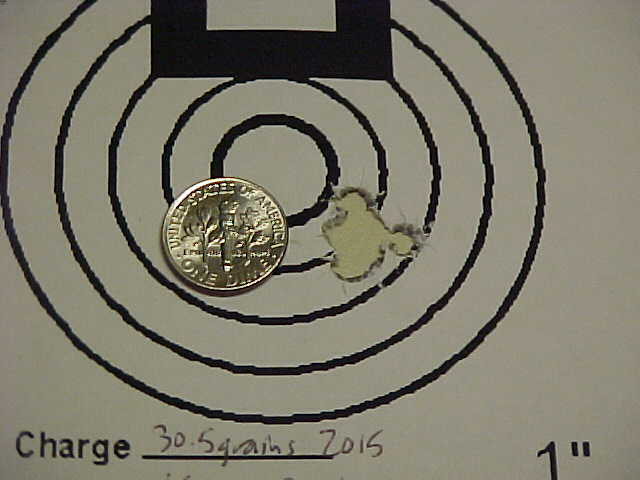
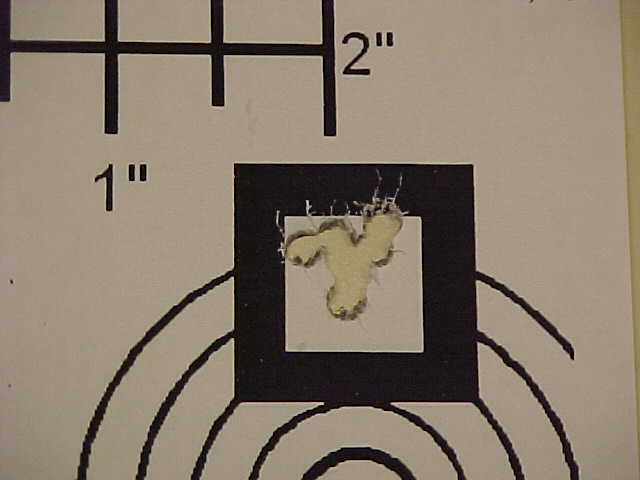
The powders that I tried were Vihtavouri n133 and Accurate Arms 2015. I had gotten some H322 that I intended to try as well, but didnt find the need to experiment further after getting the desired results with the AA 2015. I found that the load that I had the best luck with was at the book max value, but the velocity for the load was somewhat anemic. The load that I have settled on is 30.5 grains of AA 2015 behind a 65 grain Starke which chronographs at 3250 fps. Anemic or not, this is what I am using. Below is a picture of a couple of groups shot with this combination. I am pretty happy with these groups, but may change my opinion as I start to shoot my benchrest gun in 6PPC. These groups were both shot without the use of windflags, shame shame.


Image100.jpg


Image101.jpg


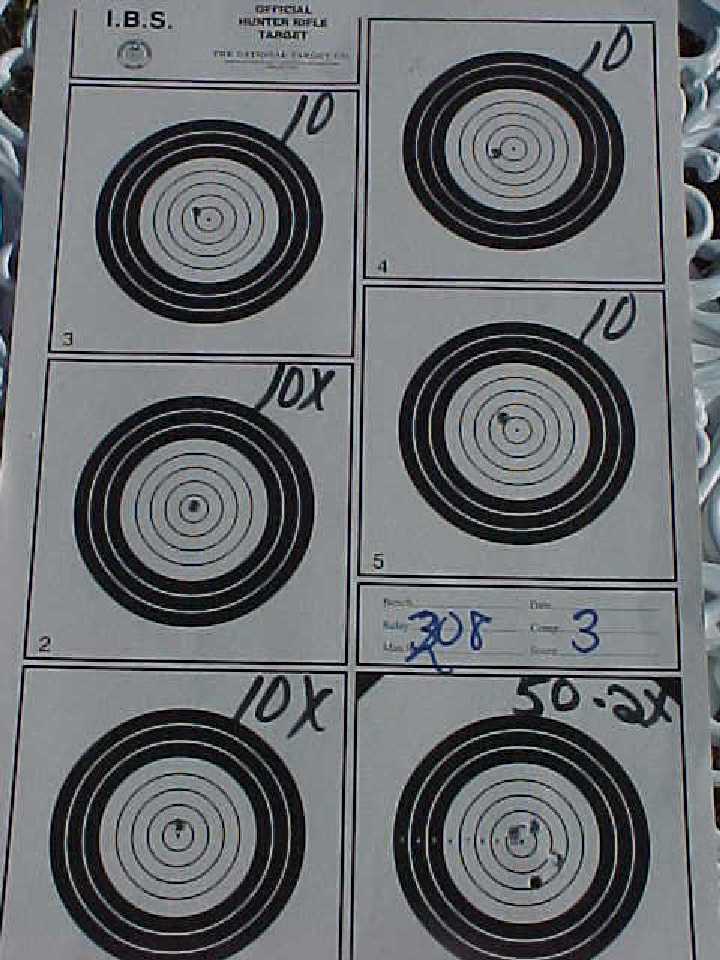
I recently acquired a benchrest rifle and was planning on attending an IBS match for score. I hadnt received the rifle but still wanted to attend the match so I took the 6BR. I was also out of the Starke bullets that I had developed the load for so I substituted some Gentner 65 grain match bullets that I had gotten for my benchrest rifle. I hadnt had a chance to try them at all before the match and the first time that I shot them was during the open range to sight in. These bullets shot to the same POI as the Starkes and seemed to perform equally as well, which should be of no surprise to any of you who have used Gentner bullets. This was my first match and was a learning experience. I was a little apprehensive about shooting the 6BR in the match considering that every other gun on the line that day was a benchrest rifle. The conditions were less than ideal (read very windy) but I was able to put the bullets into the desired location more often than not. I managed to score a 233 4x for the day. I managed to finish dead last (not including the individuals that decided to pack it in) but was still very happy with my effort. The winning score was a 249, so nobody finished clean in the conditions. I did have a clean round with a 50 2x which is shown below. I met my personal goals for the match and look forward to future matches. Bottom line, this barrel shoots great and if I read the flags well enough, it will put em in the 10 ring.


Image102.jpg


I met a lot of great people at the match and received plenty of help. I even got a few compliments on the encore (Thank you Bullberry for the terrific stock set). One gentleman a couple of benches down reminded me that I was not allowed to come to the line until I opened the bolt on my gun. Not realizing that I was being teased initially, I was not sure how to respond until I looked over and saw him grinning. I then responded that he had to disturb his gun in the bags between shots in order to even things up since I was having to deal with a break action. Come to think of it, he should have to adjust his trigger to 2 pounds also, and maybe put on a 16x scope. All in fun and I have found that to be the standard with the benchrest community thus far.


I had the opportunity to shoot a BR gun in the last round. One of the guys that I met that day offered to let me shoot his BR gun and I took him up on the offer. I was glad that I did, and it made me even more anxious to receive mine. That is the first time that I have ever looked in a 36x scope or touched a 2 ounce trigger. Wow, is all that I have to say about that. Of course, I had to deal with some serious switch winds and couldnt catch my condition. I went back to the sighter on several occasions and was only able to score a 47 1x in that round.


I hope to include a picture of me on the line with my encore, this was taken by my coach Craig Kostyshyn who finished 3rd for the match. After he gets the pictures developed, I will scan one in to post here. He has helped me enter the BR world and has been very helpful in shortening the learning curve. His score for the day was 248 7x. Second place was 248 11x.


As I write this, I am to receive my BR gun from the FFL today and am growing very anxious. It is mothers day weekend and I can only hope to find an hour or two to sneak off to the range probably will have to wait a few more days.
 
Small Caliber Load Resources - updated 4/20/2001


The Sensational Seventeens by Todd Kindler. This is a must have for .17 caliber shooting enthusiasts. It contains information on the .17CCM, .17 Hornet, .17 Hebee, .17 Mach IV, .17 Javelina, .17 Remington, .17 VLR and the .17 PPC. I refer to this manual all of the time when I am loading or whatever. It is in a 3 ring binder, and I keep all of my load data in it as well as any other articles or information that I find. These can be purchased from the Woodchuck Den (see links). Todd can tell you anything that you need to know about the small calibers.


17 Caliber Shooting by Dick Saunders. Dick is an expert in the field of small caliber shooting. He has been doing it for many years and has developed a number of cartridges including one of my favorites the 17 Jet. His manual has some stories about 17 caliber shooting and then has a lot of load information on a bunch of different cartridges. This is a must have for your library if you are reading this page. Every time I talk to Dick, I learn something new about .17s. His manual lists wildcats that he developed which are probably not available anywhere else. If you are looking for an obscure .17, start here. These manuals will have to be ordered through Dick as I am unaware of any other source. His phone number is (319)927-4026. The price for his manual at this time is $18.50. His manual has data on the following calibers:

.17 Squirrel
.17 Hornet
.17 Flickertail
.17 GSG
.17 Ackley Bee
.17 Pewee
.17 Landis Woodsman
.17 Mach IV
.17/221
.17 Javelina
.17/222
.17/222 Rimmed
.17 Mijet
.17-40 Jet
.17-40 Jet Rimless
.17-32 Jet
.17 Remington
Small Caliber News. This is a quarterly publication tailored to the small calibers. Todd Kindler is the editor. I have every edition of this magazine and use them as a resource when loading a new caliber. This is the magazine that I look forward to the most out of all of the magazines that I get every month. I have had 1 article published in SCN thus far and am submitting more in the near future. The article that I had published in posted on the page and is titled "Its a Hebee". At last check, back copies were available.


Hornady manual. I have heard that this manual has load data for the .17 Remington and the .17 Mach IV. I cant confirm this as I dont have a copy of this manual yet.


Handbook for Reloaders & Shooters Vol 1 & 2 by P.O. Ackley. This is on the top of my list of resources to get. There is some information on the .17s in these as I am told.


Professional Loading and Reloading Data by George Leonard Herter. This book is supposed to contain .17 caliber reloading information but I havent confirmed to date.


Practical Reloading Manual by Nick Harvey. This book has reloading data for the .17 Ackley Hornet, .17 Ackley Bee, .17-222, .17 Mach IV, and the .17 Remington. I now have my copy of this book and must say that his load data is the most conservative out of any that I have seen. Seems to have some good information and Im glad that I have it.


Eichelbergers .14 caliber load manual. This information was written by Eichelberger and is available from Tom Thomas at the Outdoorsman. Tom also carries the fine Cooper, Cascade, and Kimber rifles. He has a lot of small caliber supplies and I hope to make it to his shop some day. I believe that there is a .12 caliber manual from Eichelberger as well that is available at The Outdoorsman. I have the .14 caliber manual, and suggest it to anyone who is considering a .14. It includes cartridge drawings with each cartridge and gives load data on various bullet weights for each cartridge. It also provides the velocity of each load. Bill Eichelberger is the go to guy for the .14s, .12s and .10s yes thats right I said .10 caliber. I have a couple of dummy cases for his .10 caliber cartridges and have posted pictures of them under the title of Extreme Small Calibers. The .14 caliber manual includes cartridge drawings and load data on the following cartridges.

.14 Eichelberger Long Rifle
.14 Eichelberger WRM
.14 Eichelberger Dart
.14 Eichelberger Flea
.14 Cooper (CCM)
.14 Eichelberger H&R Mag
.14 Eichelberger Carbine
.14 Squirrel
.14 Eichelberger Hornet
.14 Walker Hornet
.14 Jet Junior
.14 Eichelberger Bee
.14/.221 Eichelberger
.14/.221 Walker
.14/.222 Eichelberger
.14/.222 Eichelberger Mag.

Load Data available on the Internet.


www.hodgdon.com Load data for the .17 Remington


www.accuratepowder.com Load data for the .17 Remington


www.imrpowder.com Load data for the .17 Remington


www.accuratereloading.com Load data for the .17 Mach IV, .17 PPC, .17 Remington. This site also has some load data on the .20 Vartarg and the .20 Vartarg Turbo.
 
Before I copy and paste anymore of the articles, please let me know if you guys find this worth transporting over to this thread.
 

Thinking about building a 14?​


By Russ Lucas


I get many requests from people wanting to know about building a 14, so I decided to write this article to explain what I have seen and heard in the 5years that I have been making and shooting 14's.

I own two 14's at the present time, an original Winchester High Wall, which I did all the metal work on, and a contender barrel from Bullberry, which I just acquired a month before this article. The Winchester has an 8 1/2 twist stainless barrel on it and the contender has a 24" stainless 7 twist barrel.Both barrels were made by Jeff Lawrence south of me in Polson, MT.

I use my 14's to shoot gophers mostly, a huge sport here in Montana in the spring. I guess everybody is ready after being cooped up all winter to shoot anything, and the gophers are the first unfortunate things to show their heads. I won't go into graphic details here, lets just say the high wall will just annihilate them up to 125 yards, the 7 twist contender still further to 200 yards. What is really amazing is that you can see the torque of the bullet energy in whatever it hits, throwing things to the right several feet. It isn't the forward energy of the 14 that is so devastating,it's this torque imparted from the spin. I have owned three 17's in my life so far, and there is just no comparison. One of those things that just hasto be seen to be believed.

Strangely, this energy and speed is short lived. I have shot the 8 1/2 twist on a 500 yard range, aiming at least 4 feet over the top of some largetargets. No holes. Dead on at 100, 3 inches low at 200. (there are no targets at 3 and 400 yards on that portion of the range) Anyway, what I'msaying is that the 8 1/2 twist dies somewhere between 2 and 5 hundred yards.This was with 15 grain flat base bullets.

The 7 twist is another animal. It will stabilize 17.5 grain bullets, and I have already shot prairie dogs with it and flat based bullets at 200 yards reliably. You could hear them hit! I have not tested it with the new 7s boattails, but Blaine Eddy has it and will do a test on a controlled range he has available. *Update 5/2003: The boattails do not seem to have an accuracy gain over the flat base, at least at 100 yards. Will test them inmy 7 twist when I fix the broken punch.

As far as killing power, Blaine swears by his 14/221 for hunting coyotes up to 125 yards. His is an 8 1/2 twist stainless. He calls them in, and most of his shots are under 100 yards. He says that a chest shot with them facing is instantly lethal, and they drop without taking a step. This is with the 15grain flat base moving at nearly 4400fps. We are both thinking that the 17.5grain boattail in the 7 twist will boost the kill range to 200 yards or slightly further. Fur hunters take note: ZERO pelt damage.

There have been two deer killed with a 14 that I know of. I do know of a man in S.C. that intentionally plans shooting a deer with his. If you do the math,the little bullet hits with the power of a 357, but still I think its a little un-ethical. (they are big on ethics here in Montana, and I guess a little rubbed off on me).

One deer was run over by a car, and the guy following just happened to have a contender chambered in a 14 in his trunk. The state police were called, but the officer didn't want to do the paperwork associated with firing a round from his revolver. So, the guy volunteers to shoot it with the 14. He said he backed up to get it's head in the scope, shot, and instantly killed it. Said the trooper was severely shocked.

The other was a spike that walked out on a private range while a 14shooter was sighting in his new 14. He had just got it on the paper at 50yards, when this spike walked out at 65 yards. He said that he just put the crosshairs on his neck and pulled the trigger. The deer went down with what the explained as a whiplash motion, stone dead. He said that the 17.5 grain bullet just pulverized everything in the neck, especially the vertebrae. I guess its all in the shot placement.

On the negative side, the 14's are sensitive to wind, but not as much as you would expect. I have hopes that the new boattail I'm building will buck the wind better. You cannot shoot them in the rain. Even the smallest powder charge variation will make them go crazy. One grain of powder over a normal load can pierce or ruin a primer pocket and the case. The cases are not easy to make, and are relatively expensive in my opinion. But they are available.Bullets are relatively expensive, but they are not easy to make, and are available from more than one source. You must have GREAT patience to work with a 14, because they are finicky beasts, and sometimes behave exactly opposite from what you'd expect.

So, if you're still reading and not scared off, what this all boils down to is if you want a 200 yard coyote gun, build a 7 twist 14/221 and shoot up to a 17.5 grain bullet.(maybe even a little heavier) If you want a short range squirrel/bird/gopher gun,(100 yards) build a 14 Walker Hornet or squirrel and shoot a 10, 12.5 or 14 grain bullet.

I will guarantee you two things. Once you shoot or see a 14 shot, you will want one. And you will have a lot of fun with it after you get it.
 
Savage Firearms!!!


I have been hearing for a couple of years now how well Savage Firearms shoot. I recently had an opportunity to try one and am sorry that it isnt mine. A friend from work asked me to help him find a varmint gun for shooting ground hogs and such. His primary concern was accuracy and he wanted to be able to shoot factory ammunition. I gathered some evidence from the various chat-boards on the web to share with him on the success that others were reporting. We looked on the Savage website and decided on the model 12FV. I personally would love to have the 12BVSS-S, but he opted for going with the cheaper of the two.


I had Jerry Malin from Malins gun order one for him. In less than a week, it was in and ready to be picked up. The first thing that I did was to check the trigger pull. I had heard how bad these things are, but never had actually tried one. Well it was terrible, creepy, and very heavy pull weight. Jerry offered to smith on the trigger and I encouraged John to get it done right away. The gun was left with Jerry to work on the trigger, and was picked up a few days later. With the factory trigger, Jerry was able to safely reach a 3lb pull and it was a big improvement. There are good aftermarket triggers available for the Savages, but they werent in the budget.


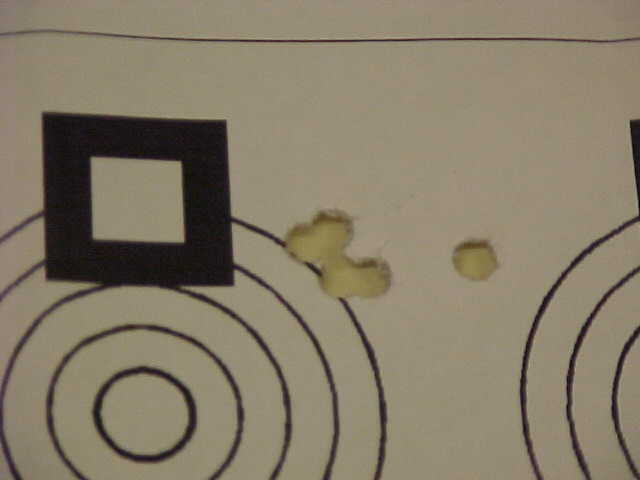
I mounted a Tasco Worldclass Target 6-24 power scope in Burris Signature Zee rings on weaver bases. I worked up some loads to try using Winchester 748 powder and 50 grain Hornady V-maxes in Federal cases with Federal match primers. After sighting the rifle in at 50 yards, I moved the target to 100 yards to shoot a group and get the scope sighted in for an inch high at 100 yards. Below is a picture of the first group that I shot at 100 yards. With the flier it measures .76". The four in the group are very tight. This was with the first powder and bullet tried.


Image86.jpg


John had now had the opportunity to shoot the rifle and get comfortable with it. He shot some 3 and 4 shot groups while we made minor scope adjustments and just about every one of his groups were less than an inch, while one of his 3 shot groups was .5". John was not very confident with his shooting ability before he shot the groups. I think that it is safe to say that there are two more Savage believers.
 
Back
Top